HISTORY
FROM THE GERMAN OCCUPATION FORCES
Liberation of Thessaloniki: written by Triantafyllos Mitafidis
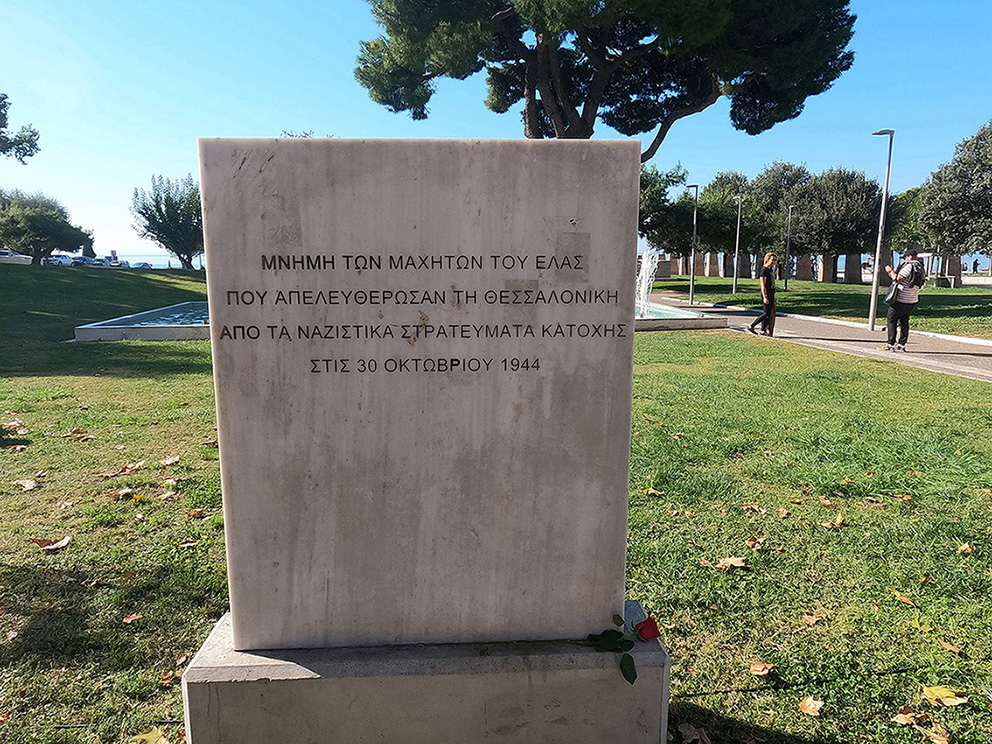
At dawn on October 30, 1944, the dead and mournful face of Thessaloniki was finally consigned to the past. Two EPON members, perched on the roof of a house in the Upper Town, announced the joyful news to the Lower Town with their makeshift megaphone: «Brothers, fellow citizens, our famous city, which for four years groaned under the fascist boot but never ceased to resist, is finally free. Long live free Greece! Long live freedom! Long live unconquered Thessaloniki! Long live the liberators of ELAS! We will never forget the brave and courageous who showed us the way to freedom with their lives. Eternal honor and glory to our heroes…» (Stelios Georgiadis, «Thessaloniki, the rebellious city,» 1995, p. 292).
Liberation of Thessaloniki: The intervention
The second liberation of Thessaloniki on October 30, 1944, was carried out exclusively by the EAM resistance forces and their military arm, the ELAS. Despite the Caserta Agreement, which stipulated that power should be handed over to the British under Commander-in-Chief Scobie, as had happened in Athens and other cities, and despite the orders of ELAS commander Stefanos Sarafis, to remain on the outskirts of the city and await the British landing, the leaders of the Macedonian Division Group, Markos Vafeiadis and Evripidis Bakirtzis, did not obey the orders from above.
Thus, thanks to the timely intervention of the Hellenic Police Reserve, the retreating Nazi occupation forces did not manage to blow up the port of Thessaloniki (except for one section), the power company, its aqueduct, and the Allatini mills, as threatened by the military commander, Colonel Miller Osten.
Liberation of Thessaloniki: Entry into the city
After 1,296 days of Nazi tyranny and genocide of our fellow citizens of Jewish origin, the fighters of the ELAS liberated Thessaloniki and entered the city, led by Kostas Synnefakis (Captain Nikitas), commander of the 50th Regiment.
It is worth referring to what important intellectuals of our city who lived through its liberation from the Nazis wrote. A city that can boast that it was among the first in occupied Europe where a resistance organization was founded: On May 15, 1941, ELEFTHERIA was founded in the Ampelokipoi neighborhood, with the secret newspaper of the same name.
Liberation of Thessaloniki: The description
This is how Giorgos Ioannou describes the celebrations for the city’s liberation in his «prophetic,» as it turned out, text «The Overdue Liberation.»
«Meanwhile, the crowds were pushing toward Agia Sofia Square. That is where all the foaming rivers ended up. From Agia Sofia Street, the children—and not only the children—of Koule Cafe, Agios Pavlos, Acropolis, and Kassandros descended, sweeping through the neighborhoods. Tsinari, Eski Delik, Profitis Ilias, and Dioikitirio descended Venizelos Street. They had a better road, not only downhill but also wide and paved, and they walked more briskly.
From Vardari again came Ramona, Eptalofos, Paleos Stathmos, Neapoli, and Stavroupoli, barefoot, ragged, hungry, and bursting with excitement, while from the east they arrived in a cloud of dust and noise with trumpets, panties, and lava. Neapoli, Stavroupoli, while from the east, amid dust and noise, with trumpets, banners, and horns, came Toumba—which they called «Toumba-Stalingrad»—Agia Fotini, Evangelistria, Triandria, and even distant Kalamaria. The streets and squares were flooded with pandemonium. We kissed, hugged, and caressed each other, not knowing what we were saying in our excitement. We chanted «Christ is risen,» «Freedom,» «Never again.» As if it were in our hands. But that’s what you think in moments like these.
Liberation of Thessaloniki: The Provisional Committee
The Provisional Municipal Committee, which had been set up in the YMCA building after the surrender of the Tagmatasfalites and the Gendarmes, where they had barricaded themselves, took over, headed initially by former Rector Dimitris Kavadas and doctor Leonidas Karamaounas, the titanic task of healing the wounds and rebuilding the city, based on the pro-people program of the EAM. Thus, Thessaloniki, unlike Athens, will not experience the hardships of the December events.
Eighty years after the end of World War II and thirty-five years after German reunification, the Federal Republic of Germany, despite being the «universal successor to the Third Reich,» refuses to take responsibility for the unspeakable suffering caused by Nazi Germany in Greece and continues to violate its signature on the 1953 London Treaty. A Germany that, instead of learning the lessons of the two World Wars, is spearheading a Cold War-style arms race worth over €800 billion (ReArm Europe Plan/Readiness 2030).
We call on the Prime Minister and political leaders to implement the unanimous decision of the Hellenic Parliament of April 17, 2019, and to proceed with the decisive claim of German debts. This is a practical expression of the Greek Republic’s respect for the struggles and sacrifices of our people and a powerful message of justice. Because crimes against humanity, whose perpetrators have not been punished and whose victims have not been morally and materially compensated, are repeated. This is what we are experiencing today.